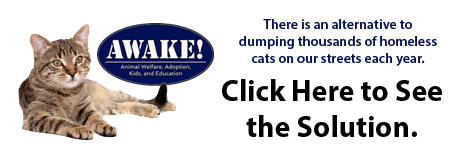



Support AWAKE! and oppose the Florida “Community Cat” Feral cat bill.
This is ONLY for residents of Florida.
Dear Citizens,
Two bills are before the Florida legislature that would badly risk our public health and cause major damage to our wildlife. Cat extremists want to keep cats out of shelters by releasing them all onto our community streets, making them homeless and endangering public health and other animals as well as the cats that are released. This is unacceptable on numerous fronts. Thank you for taking the time to get involved in this important issue. As veterinarians, we endorse AWAKE! as a newer, and more innovative, approach to the management of feral cats. The old way of TNR is simply not working, and creates too much risk to public health, wildlife and the feral/stray cats. We agree with the senior medical director of the Humane Society of the United States’ Veterinary Association. Dr. Kellogg, who observes, “it is clear that effective solutions to the problems of free-roaming cat overpopulation and wildlife predation will have to include newer and more innovative approaches.”
Please fill out the following form to send an email message to Florida State Senators and Representatives:
The following message is what will be sent to your Florida State legislators:
Dear Legislator,
As a Florida resident, I respectfully request you do not support H.B.1121 and its companion S.B. 1320. These bills gravely endanger our public health and decimate our wildlife by sanctioning TNR (“trap-neuter-return,” which effectively means “re-abandon”). The very fact feral “community cat” programs are seeking legal immunity is all the evidence needed to demonstrate the dangers associated with TNR.
The Florida Department of Health (FDOH) warns against these programs in the 2012 Rabies Guide, writing, “The concept of managing free-roaming/feral domestic cats (Felis catus) is not tenable on public health grounds because of the persistent threat posed to communities from injury and disease. While the risk for disease transmission from cats to people is generally low when these animals are maintained indoors and routinely cared for, free-roaming cats pose a continuous concern to communities. Children are among the highest risk for disease transmission from these cats.” These clearly stated risks are why most human doctors, wildlife organizations, and veterinarians are against TNR programs.
(This part can be personalized:)
New reports show conclusively that feral cats are the number one decimator of birds and native wildlife, and the carrier of 16 diseases including Rabies, Cat Scratch Disease, and Toxoplasmosis. I do not support the effort to sanction “community cat” programs that are the antithesis of Responsible Pet Ownership. There are newer, and more innovative, methods to humanely care for feral cats; and “community cat” programs ignore these newer methods. Instead, TNR programs imperil our natural resources and risk the public health. The FDOH notes, “Allowing cats to roam free is not in the best interests of the community’s health and deliberate release or abandonment of feral or domestic cats is not sanctioned under Florida’s conservation and cruelty laws. Domestic cats are not “indigenous” or native to Florida, and relocating and releasing non-native species into the wild is a violation of Florida Statute 379.231 and Florida Administrative Code 68A- 4.005.”
(End of personalization)
The proposed bills would effectively legalize an activity that the FDOH strongly recommends against in its 2012 Rabies Guide. Please do not endanger our communities by sanctioning the support of feral cats.
Sincerely,
(Your Name)
(Your Address)
(City, State, Zip)